Round 2 or 22 on Value-Added Testing
Posted on | February 10, 2011 | Comments Off on Round 2 or 22 on Value-Added Testing
I’ve written a piece for the Huffington Post and Thoughts in Public Education about the reanalysis of the value-added teacher evaluation exposé published by the Los Angeles Times last August. Derek Briggs, who heads the research and methodology program at the University of Colorado at Boulder, and doctoral student Ben Domingue used the same data at Richard Buddin, who ran the analysis for the Times.
They got different results. Not unexpected. And they wrote a 32 page technical report showing how and why they got different results. Nothing strange there.
The report was sponsored and issued by The National Education Policy Center, a reliably left-of-center organization that is in part financed by teacher unions, and the press release had more of the in-your-face quality than I would have liked to see. Nevertheless, the Briggs and Dominque were free to pursue the work as they wished. Briggs is a veteran of value-added research work and an expert on causal analysis. They completed their work, and the final report was not altered or spun by NEPC.
The same cannot be said about the L.A. Times reporting of the piece, and that is the major point of my HP piece. When a newspaper goes from reporting events that take place to creating the events, which is the case with the value-added teacher evaluation story, then its handling of contrary opinions and evidence must be straightforward. Monday’s story was anything but that. It spun the story to make it look as if Briggs and Dominque essentially agreed with the Times analysis.
(It also broke the embargo on the story’s release (everyone else with the exception of a Washington Post blogger) played by the rules, but that’s a relatively minor issue, even though it really tees off other journalists.)
The larger point is that if value added analysis is going to be accepted as a reasonable form of research and if it is going to be applied to individual teachers rather than entire schools, very careful work needs to be done in order to polish the method and make it credible. The Times stonewalling prevents an important public policy discussion from taking place. There has been a barrage of scholarly and policy criticism of the Times. Little of it has gotten serious attention in the paper.
Claremont Colleges Talk on “Learning from L.A.” Available On-Line, Here
Posted on | February 1, 2011 | Comments Off on Claremont Colleges Talk on “Learning from L.A.” Available On-Line, Here
The good people at the Honnold Library have edited my talk from last November and integrated it with the slide show. It is available at the Library’s web site.
A Cautionary Story About Merit Pay
Posted on | January 26, 2011 | Comments Off on A Cautionary Story About Merit Pay
In a just published piece on the PACE blog, I talk about the unintended consequences of paying teachers based on student results. In the long run, actually much more quickly than one might think, Talent will organize to insure its economic success. The blog piece retells the story of how baseball players became superstars with outsized paychecks. It’s a long way from teacherdom, and teacher salaries to major league baseball, but the principle holds: if you name something, and say that it is valued, it is likely to have economic consequences. I am not at all sure that pipers of economic competitiveness among teachers have figured out the cost of the tune they are playing. But some smart union organizer will. Read the whole piece here.
Tags: Malcolm Gladwell > Merit pay
Education Diagnosed in 10 Minutes
Posted on | January 8, 2011 | Comments Off on Education Diagnosed in 10 Minutes
Sir Ken Robinson’s remarkable way of summarizing the world is making its way around the Internet. At last count, nearly 2.5 million hits. See this from TED. The problem in the current system, he notes, is that the people are trying fix the future by replicating the lessons from the Enlightenment and the industrial revolution. He takes a swipe at age-group batch processing, ADHD, standardized testing and teaching. “I believe we have to go in the exact opposite direction.” Enjoy.
Teacher-Run School Gets Good Ink
Posted on | December 31, 2010 | Comments Off on Teacher-Run School Gets Good Ink
The Avalon School in St. Paul, which I profiled in a case study (available freely by clicking the Projects link) has received a nice mention in the Minneapolis-St. Paul Star-Tribune. The story was also linked in Education Week, and a Forbes magazine blog. It’s good to have this work seen and used. And this from Joe Nathan via Tom Vander Ark in The Huffington Post; also in the Carnegie Foundation blog.
Short thoughts on a sunny Christmas afternoon
Posted on | December 25, 2010 | Comments Off on Short thoughts on a sunny Christmas afternoon
The rain has ended and the snow-clad San Gabriels look down on Claremont today. It was a starry Christmas Eve, and I gathered with friends and congregants to sing Silent Night at Midnight by candlelight. I have experienced the service of Lessons and Carols for more than half a century, and it still moves me. Our little Presbyterian congregation is blessed with extraordinary music. Jenelle Westerbeck Anderson, Jerry DeMasi, and scores of others brought the evening the majesty and wonder it needed.
Today in particular is is worth reflecting on the last paragraphs from Robert Putnam and David Campbell’s New book on religion in America:
How has America solved the puzzle of religious pluralism–the coexistence of religious diversity an devotion? And how has it done so in the wake of growing religious polarization? By creating a web of interlocking personal relationships of people of many different faiths.
This is America’s grace.
Or to quote Howard Rice’s bumper sticker: God loves the whole wide world; no exceptions.
Speaking at PACE Seminar in Sacramento on December 17
Posted on | December 6, 2010 | Comments Off on Speaking at PACE Seminar in Sacramento on December 17
Upcoming Seminar: Learning from LA: Policy Levers for Institutional Change
Please RSVP to Sandra Morales or (916) 669-5425.
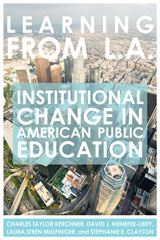
The history of the Los Angeles Unified School District over the past five decades, reveals an organization pulled up from its early 20th Century Progressive Era roots. Decades of reform efforts have provided a lively audition for what a new institution of public education could look like. But public policy and the surrounding political system have created an atmosphere of continuing crisis rather than a new institutional stability. In this seminar Charles Kerchner reviews the recent history of LAUSD, drawing from the recent book, Learning from L.A.: Institutional Change in Public Education. He shows how successive reform efforts have outlined the design of a more effective educational system, and identifies some policy levers that can help to create a new institutional structure for public education, in LA and for all of California and beyond.
More information on upcoming PACE seminars can be found at http://pace.berkeley.edu
Teacher-Run Schools and the History of Worker’s Cooperatives
Posted on | November 24, 2010 | Comments Off on Teacher-Run Schools and the History of Worker’s Cooperatives
Following our case study on teacher-run schools, Henry Levin wrote to remind me of Worker Cooperatives in America, a 1984 book he co-edited with Robert Jackall. It still offers pertinent insight into the opportunities and problems of worker owned and operated organizations. “[T]he affective ties which are the basis for selection into collectives bind workers to one another and to their groups in very intense ways. One one hand, such ties provide collectives with a resiliency that is necessary to cope with their marginality; on the other, they personalize and thus intensify even routine disputes, often producing tangled emotional situations that are very difficult to reconcile. Many cooperatives founder on the very intensity that is their hallmark.” (95-96)
It is not surprising that cooperatives are again drawing attention; founding them is a historic reaction to hard times. Last night, PBS aired a NOW show on local sourcing, and job creation, including cooperatives.
It is unfortunately the case that our society is so attuned to hierarchical control that we do not train ourselves, our students, or our children in other possibilities.
Annotating Jerry Brown: Comments on the Governor-Elect’s Education Plan
Posted on | November 20, 2010 | Comments Off on Annotating Jerry Brown: Comments on the Governor-Elect’s Education Plan
Mike Kirst chided me for not paying attention to Jerry Brown’s education plan in earlier comments about what he should do as governor. So, I took another look. It’s smart, pragmatic, and a little pregnant. See the post at Topics in Public Education. Comments invited.
The Buzz About Teacher-Run Schools
Posted on | November 18, 2010 | Comments Off on The Buzz About Teacher-Run Schools
The media have discovered teacher run schools in a big way. Christine Hoag of the Associated Press wrote about the Woodland Hills Academy in Los Angeles, which converted to a teacher-run school, albeit one with a principal. Her story has been published throughout the country, and has received substantial attention. Alan Coverstone wrote a supportive opinion piece in the Nashville Tennessean as did Gera Summerford, president of the Tennessee Education Association. Hoag’s article as published on the Huffington Post received a large number of comments. My case study on teacher run schools continues to be available by clicking the link in the next column.
Interestingly, Woodland Hills Academy exists within the Los Angeles Unified School District, which I believe is rapidly becoming a national model for how a public school district can assemble a portfolio of schools operated in diverse ways. WHA serves a racially mixed student body, about 30 percent white, 47 percent Latino, with about half the student eligible for free or reduced price lunch.
Thanks to Kim Ferris-Berg for circulating the links.
'On California' at EdWeek.org
I have concluded my opinion blog on the Golden State's politics and education policies at EdWeek.org. An archive of the 281 posts can be reached by clicking HERE
Learning 2.0
Learning 2.0 is the next full scale version of public education, one that builds on the capacity of the Internet age.
The five elements of Learning 2.0 are explained by clicking HERE:
- Mixing acquisition of knowledge and practice, head and hands.
- An individual education plan for everyone.
- Understanding that students are the real workers in the education system.
- Unbundle teaching, testing, and mentoring.
- Add collaboration and solving tough, ambiguous problems to the list of basic skills.
Recent Posts
- Give Us 25 Minutes; You’ll Get Better 24 Hours
- New Stories on How California Flipped 7 U.S. House Seats from Red to Blue
- Old at the Beach
- A 4th of July Salute to a Courageous Judge: Remembering Paul Egly
- It’s More Than Resistance to Trump
- ‘Dreamers’ Find Allies Among Their Teachers
- How To Make the Next LAUSD Superintendent Successful
- Go, Visit the Whitney Plantation
- Nomadland: Exploring America’s Mobile Army of Older Workers
- Here’s The Peace Dividend In Los Angeles Charter School Wars
Recent Projects


About
 Charles Taylor Kerchner is an Emeritus Professor and Senior Research Fellow at Claremont Graduate University. My daily musings appear in the blog. The archives of my EdWeek blog are available via link under the 'On California' head. Some of my photography can be seen by clicking on 'Gallery.' And numerous links to academic work and other research and commentary can be found by clicking on 'Projects.'
Search
Subscribe to my Blog
Archives
- August 2020
- July 2019
- August 2018
- July 2018
- April 2018
- February 2018
- January 2018
- December 2017
- November 2017
- September 2017
- August 2017
- July 2017
- December 2015
- September 2015
- September 2014
- May 2014
- April 2014
- March 2014
- February 2014
- January 2014
- December 2013
- November 2013
- October 2013
- September 2013
- August 2013
- July 2013
- June 2013
- May 2013
- April 2013
- March 2013
- February 2013
- January 2013
- November 2012
- October 2012
- July 2012
- April 2012
- March 2012
- February 2012
- January 2012
- December 2011
- November 2011
- October 2011
- September 2011
- August 2011
- July 2011
- June 2011
- May 2011
- April 2011
- March 2011
- February 2011
- January 2011
- December 2010
- November 2010
- September 2010
- August 2010
- July 2010
- June 2010
- May 2010
- April 2010
- March 2010
- February 2010
- May 2009
- August 2008
- June 2008
- September 2007
- August 2007
- December 2005
- June 2005
- January 1999
Blogs I Read
- Arts & Letters Daily
- California Watch, reporting from the Center for Investigative Journalism
- Conditions of Education from PACE
- District Dossier
- Ed Source Today
- Joanne Jacobs–Linking and Thinking
- L.A. School Report
- Politics K-12: Michele McNeil and Alyson Klein
- Rough & Tumble: Today's California Politics News
- Teacher Beat: Stephen Sawchuk
- The Hechinger Report
- The Quick and the Ed–Education Sector
- This Week in Education: Alexandar Russo