“A New Culture Of Learning”: Dewey Redux
Posted on | April 24, 2011 | Comments Off on “A New Culture Of Learning”: Dewey Redux
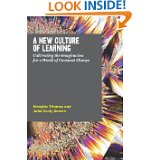 Two of the gurus of the Internet age have written a charming, compelling, and ultimately romantic book about what learning could be.
In the opening pages of A New Culture of Learning: Cultivating the Imagination for a World of Constant Change, Douglas Thomas and John Seely Brown lay out the dimensions of “arc of life” learning “which comprises the activities in our daily lives that keeps learning, growing, and exploring” (p. 18). (The book is self-published and available exclusively at Amazon.com.)
A New Culture of Learning starts out with a story about Sam. Sam is 9. He started playing with a computer program called Scratch, created at MIT to help kids understand the basics of design. Sam learned a lot. Within a few minutes he could create basic animations, but then Sam found out he was not alone in his efforts. A community of other kids was on line, and when Sam posted his game others could experiment with it, comment, build on it, and collaborate. Sam had entered the new culture of learning: play, collaboration, questioning, and imagination.
New learning may be child’s play, but it is vexing to adults, and it brought to my mind a much older volume featuring playful children connecting learning to the community, John Dewey’s School and Society, published in 1900. Dewey, too, wanted schools to individualize learning experiences, connect schooling to learning about the means of production, and wanted kids to explore and discover.
I am attracted to the world that Thomas and Seely Brown describe, a world in which a “bounded and structured environment that allows for unlimited agency to build and experiment within things within those boundaries” (p. 19): in other words, a space with rules and lots of freedom within that space. As the authors later reveal, their concrete version of the new culture of learning looks a great deal more like a massive, multiuser computer game than it does a conventional classroom. Much of what they advocate in A New Culture of Learning, is consistent with my thoughts in Learning 2.0.
But the story of education in the 20th Century is in large part a tale of how Dewey lost. Despite his damning commentary on waste in education, Dewey’s pedagogical ideas fell victim to the organizational mandates of industrial efficiency. Where Dewey had sought individualization, industrial efficiency produced a batch processing system. Where Dewey had sought matching school to student, industrial efficiency created tracking and social separation.
No less than Dewey did, the advocates of new learning face an existing institution that needs substantial positive incentives to change. Technology may change our children’s heads, but it is the legislatures and interest groups that will change the rules of the game.
(For a longer essay review of the A New Culture of Learning and Dewey’s School and Society, click here.)
Tags: "A New Culture of Learning" > California > Doug Thomas > Education Reform > John Dewey > John Seely Brown > Mimi Ito
Why Now? The Dark Days Possibilities of Learning 2.0
Posted on | April 9, 2011 | Comments Off on Why Now? The Dark Days Possibilities of Learning 2.0
 [A revised version of this post appears in Thoughts on Public Education.]
As I was thinking about writing this post, my attention wandered (yes, it does) to Stephen Sawchuk’s Education Week story about Monica Iñiguez, a 4th grade teacher in Los Angeles Unified who has received her third budget-driven pink slip in six years of teaching. Her husband got one, too, and their house is in escrow. When times are so dire—19,000 of Iñiguez’s fellow California teachers got layoff notices—how is it possible to think positively about public education’s future? That is what I advocate in my series Learning 2.0.
The answer is that this is the very best time to think, plan, scheme, and politic about the future of public education. Three aspects of the current condition make it so:
First, the mind and psyche need to flee the darkness. At historic times of darkness, we seek the light, because doing so give us hope. The 37th Congress meeting in the depths of the Civil War, passed the Morrill Act that underwrote public colleges and universities across the country, the Homestead Act that opened land west of the Mississippi to settlement, and the Pacific Railroad Act provided funds to link the coasts.
Second, it takes the opportunity to build differently. When times are flush, the public instinct is to do more of the same rather than to design something new. During California’s last big period of flush budgets, it poured billions into unsustainable class size reductions. Those funds may have temporarily helped a cohort of students—some of the same students that are now being frozen out of places at the state’s college and university system because of cutbacks—but they didn’t fundamentally change or challenge.
Third, thinking anew is the first stage of political action. Public education, particularly in the cities, has become a bad brand, something that no one wants to buy. Only with a better idea and a clear notion of how to move toward it will it be possible to move forward.
Monica Iñiguez needs a good, steady job. The best way we can help her protest is to help design a better system of public education. Consider Learning 2.0.
Fasting Because Budgets are Moral Documents
Posted on | April 2, 2011 | Comments Off on Fasting Because Budgets are Moral Documents
 The practice of fasting is testament-honored but not much practiced these days, as any trip to the shopping center or the movie snack bar will reveal. But starting this week, I along with more than 20, 000 Americans will be partial fasting for economic justice. Jim Wallis and a number of other clergy have announced a fast, and I have decided to join, because, like them, I believe that budgets are moral documents and that advocating cutbacks in basic aid to the poor–such as Food Stamps–is moral bankruptcy. Move-On, whose leadership is also joining, announced its participation with these lines from Isaiah:
Is this not the fast that I choose:
to loose the bonds of injustice,
to undo the thongs of the yoke,
to let the oppressed go free,
and to break every yoke. (58:6)
Understanding the Kahn Academy
Posted on | March 23, 2011 | Comments Off on Understanding the Kahn Academy
In Learning 2.0, I reference the Kahn Academy, the wildly successful and growing open-source video tutoring program. Here Salman Kahn talks about how his video lectures have penetrated regular classrooms. By removing the one-size fits all classroom, the teachers have used technology to humanize the classroom. His TED speech here. Listen to his notions about encouraging failure and experimentation. Also, see the experiment in Los Altos, where the Academy videos are being used a few classrooms instead of the regular text. (Thanks to Adriana Publico for bringing this to my attention.)
Tags: Kahn Academy > Learning from failure > TED
The Elephant on the Mountain:
Posted on | March 23, 2011 | Comments Off on The Elephant on the Mountain:
or how to talk about public education without mentioning the financial crisis hardly at all
I had a good time at Tuesday’s self-styled Education Summit. United Way, which put on the meeting, did a fine job of organizing and packed a lot of content and good will into a half-day. I’ve written a cover story and some thoughts for Thoughts on Public Education and Conditions of Education in California. But I was taken by the failure to join the issue of the current financial crisis.
Maybe I don’t get it, but as I recall, school districts in the state issued 19,000 layoff notices last week and a very large percentage of these will become real layoffs if two things don’t happen soon.
First, the legislature has to authorize an election in June. Second, voters have to agree to extend current taxes…not raise them, simply extend them.
Anyone who read today’s papers knows that there is a stalemate in Sacramento. Gov. Jerry Brown’s plan to close the state $26 Billion deficit through a combination of tough love expense cuts, which come on top of last year’s cuts, and extension of existing taxes has garnered a solid wall of Republican opposition.
At the summit, L.A. Mayor Antonio Villaraigosa pled for help with revenue as did incoming Los Angeles Unified superintendent John Deasy. But I did not hear one person from the business community, the Chamber of Commerce, the United Way or anyone else get up and say: “we can deliver a Republican vote.” No one even threw a snowball at the elephant.
I do not believe that a new round of civic engagement in education will get traction until the business community comes to the table ready to make a deal with the elephant on the mountain. Unless they are willing to speak truth to the power of the Republican Party, the folks at the summit will have a disappointing view.
Tags: Arne Duncan > California > Education Reform > Education Summit > LAUSD > Taxes
All about me
Posted on | March 15, 2011 | Comments Off on All about me
Megan Driscoll interviewed me for the Education Portal site. My response, probably more than you wanted to know, is available here.
Learning 2.0
Posted on | March 8, 2011 | Comments Off on Learning 2.0
“Why, one might ask, should California, the headwaters of the digital revolution, be stuck in the eddies of an early 20th Century school design?”
 Starting this week, I will be posting a series of pieces about the what I believe to be the essentials of 21st Century learning and the changes in educational politics that I believe are necessary to get there. Learning 2.0, as the series of pieces will be titled, is a worthy successor to an older institution of education.
The three of these pieces are being posted on the Policy Analysis for California Education blog, Conditions of Education. The three together are available in pdf form here. Other parts will find their way into Thoughts on Public Education and other venues. All of them will be referenced here, and if you wish to keep up with the series as it rolls out, you can subscribe to this blog. Or if you wish, I will send you an email when new posts are up. Just click Contacts and send me the relevant information, and I will add you to the distribution list.
Tags: California > Education Reform
Understanding the New Network Economy
Posted on | March 5, 2011 | Comments Off on Understanding the New Network Economy
 Yochai Benkler is the kind of polymath that eclipses ordinary academics. A law professor at Harvard, he also directs the Berkman Center for Internet and Society, which has as its modest mission “to explore and understand cyberspace.” In prior lives, he was the treasurer of a kibbutz in Israel, a practicing lawyer, and a clerk for U.S. Supreme Court Justice Stephen Breyer. But notably, he has recast economics, and he forecasts what may be the political debate of the century. Read more
Speaking at UCLA Law School on Monday, March 7
Posted on | March 4, 2011 | Comments Off on Speaking at UCLA Law School on Monday, March 7
I finally get to go to law school! The otherwise bright students at UCLA have invited me to lead a panel that discusses education reform. Details follow: Read more
A Real Cheesehead: Public Sector Collective Bargaining Under Attack in Wisconsin
Posted on | February 13, 2011 | Comments Off on A Real Cheesehead: Public Sector Collective Bargaining Under Attack in Wisconsin
The extent of the attack on public sector collective bargaining has taken me by surprise. I had expected that Republican victories in November would lead to a hardening of attitudes, but the extent and spread has been breathtaking. There are reports of an initiative to repeal collective bargaining in California, but that may well amount to nothing. Anyone can take out initiative papers; it takes $1-million plus to qualify one for the ballot and a lot more for passage. The pointy end of the attack comes in Wisconsin where Republican Gov. Scott Walker, has proposed drastic limitations on collective bargaining as well as rollbacks of wages and pensions.
My reading of the proposed legislation, which is expected to pass a Republican controlled legislature, is that it will limit collective bargaining to only base wages, and thus items such as health care, overtime, vacations, sick days, and other compensation would not be bargainable. Police and firefighters are not covered by the pending legislation. Good thing. The governor may well need them to keep order. In an interview, he said that using the National Guard was not out of the question.
Clearly, the legislation is aimed at weakening the unions, not just balancing the state budget. It would eliminate payroll deduction of union dues, a provision that is the financial lifeline of unions. It would also allow a member to withhold dues. It would require employees to hold a secret ballot election every year on whether they should remain unionized, and it would require labor contracts to be renegotiated every year. The language of the proposed statute also allows employers to terminate any employee who engages in a labor protest, not a strike, any labor protest.
Gov. Walker has also apparently simply cancelled existing contracts. I am not sure of the legal authority involved, but a letter was sent to union leaders by the state labor commissioner effectively ending contracts effective March 13. (You can follow the Wisconsin situation via The Wheeler Report.)
Also, there has been legislation introduced in Tennessee to totally eliminate collective bargaining for teachers and in Idaho and Indiana to restrict the scope of bargaining. Similar threats are being considered in Ohio and New Jersey.
All of this runs in the wrong direction.
In United Mind Workers we proposed to tweak collective bargaining by making it responsive to the education quality needs of schools and the interests that teachers have in determining the dimensions of their own work. Thus, we generally wanted to expand rather than contract the topics under discussion.
Mark Simon, who was the executive director of the Montgomery County, MD union responded to the Education Week article. I agree with his position:
“Shortsighted” is an understatement. This is the opposite of what legislatures should be doing. Rather than ensuring that teachers’ unions focus only on the narrow issues of pay and hours, policy makers should be trying to get teachers and their unions to focus on elevating the quality of teaching and improving student learning, This development in these three states amounts to narrow Republican politics, pursued at the expense of what’s best for kids. Finally teachers’ unions have started to engage in collaborative efforts to improve teacher evaluation, to struggle for better measures of student learning, to get serious about the kind of supports that new teachers receive, and creative ways to ensure that teachers voices are heard at the school and district-wide. Progressive contracts in places like Baltimore, Boston, Memphis, Chatanooga, LA, Portland(ME), and elsewhere need to be encouraged. These moves toward professional unionism and the creation of professional growth systems to improve the quality of teaching are fragile and need to be encouraged. School districts need their unions to be focused on exactly these issues. Elected officials who aim to push the unions back into their wages and hours box as if they were dealing with industiral workers, or worse, political enemies, should be ashamed.
But the politicians aren’t the only ones who are shortsighted. Many of us have been urging the NEA and the AFT to move rapidly beyond their industrial-assumption origins, but they have been glacially slow in doing so. In California, at least, that chance still remains.
A Question for Some Law Students
I have been asked by some bright law students at UCLA to talk with them about labor law and school reforms. This is a huge topic, which can only be introduced here, and I certainly cannot follow current events. But here is a question:
Should teachers be organized as a profession? If the answer is “yes,” then: What legal establishments should be used for their organization? If the answer is “no,” then: What kind of occupation would you consider teaching to be, and what, if any, rights would you give teachers?
Responses from law students and others encouraged.
« go back — keep looking »'On California' at EdWeek.org
I have concluded my opinion blog on the Golden State's politics and education policies at EdWeek.org. An archive of the 281 posts can be reached by clicking HERE
Learning 2.0
Learning 2.0 is the next full scale version of public education, one that builds on the capacity of the Internet age.
The five elements of Learning 2.0 are explained by clicking HERE:
- Mixing acquisition of knowledge and practice, head and hands.
- An individual education plan for everyone.
- Understanding that students are the real workers in the education system.
- Unbundle teaching, testing, and mentoring.
- Add collaboration and solving tough, ambiguous problems to the list of basic skills.
Recent Posts
- Give Us 25 Minutes; You’ll Get Better 24 Hours
- New Stories on How California Flipped 7 U.S. House Seats from Red to Blue
- Old at the Beach
- A 4th of July Salute to a Courageous Judge: Remembering Paul Egly
- It’s More Than Resistance to Trump
- ‘Dreamers’ Find Allies Among Their Teachers
- How To Make the Next LAUSD Superintendent Successful
- Go, Visit the Whitney Plantation
- Nomadland: Exploring America’s Mobile Army of Older Workers
- Here’s The Peace Dividend In Los Angeles Charter School Wars
Recent Projects

About
 Charles Taylor Kerchner is an Emeritus Professor and Senior Research Fellow at Claremont Graduate University. My daily musings appear in the blog. The archives of my EdWeek blog are available via link under the 'On California' head. Some of my photography can be seen by clicking on 'Gallery.' And numerous links to academic work and other research and commentary can be found by clicking on 'Projects.'
Search
Subscribe to my Blog
Archives
- August 2020
- July 2019
- August 2018
- July 2018
- April 2018
- February 2018
- January 2018
- December 2017
- November 2017
- September 2017
- August 2017
- July 2017
- December 2015
- September 2015
- September 2014
- May 2014
- April 2014
- March 2014
- February 2014
- January 2014
- December 2013
- November 2013
- October 2013
- September 2013
- August 2013
- July 2013
- June 2013
- May 2013
- April 2013
- March 2013
- February 2013
- January 2013
- November 2012
- October 2012
- July 2012
- April 2012
- March 2012
- February 2012
- January 2012
- December 2011
- November 2011
- October 2011
- September 2011
- August 2011
- July 2011
- June 2011
- May 2011
- April 2011
- March 2011
- February 2011
- January 2011
- December 2010
- November 2010
- September 2010
- August 2010
- July 2010
- June 2010
- May 2010
- April 2010
- March 2010
- February 2010
- May 2009
- August 2008
- June 2008
- September 2007
- August 2007
- December 2005
- June 2005
- January 1999
Blogs I Read
- Arts & Letters Daily
- California Watch, reporting from the Center for Investigative Journalism
- Conditions of Education from PACE
- District Dossier
- Ed Source Today
- Joanne Jacobs–Linking and Thinking
- L.A. School Report
- Politics K-12: Michele McNeil and Alyson Klein
- Rough & Tumble: Today's California Politics News
- Teacher Beat: Stephen Sawchuk
- The Hechinger Report
- The Quick and the Ed–Education Sector
- This Week in Education: Alexandar Russo