A Note about GLOW, the Scottish Education Intranet
Posted on | April 3, 2010 | Comments Off on A Note about GLOW, the Scottish Education Intranet
 I wrote a short piece in the Huffington Post today about Glow, the Scottish investment in an intranet system. It’s worth a longer look, and I am overdue in finishing up a descriptive analysis of how it works and how it was created.
There are three important things to realize about Glow:
First, it is not about technology for its own sake. Think of it as a teaching utility that makes collaboration possible. Glow links teacher-created lessons with the national curriculum, allowing both standards and variation to exist at the same time. In a sense, it manages the paradox of centralization and decentralization.
Second, it is a testimony that politics and government can tackle a big project, bring it in under budget, and create lasting infrastructure in education. It took a decade to move Glow from first thoughts to countrywide roll-out. During that time literally thousands of people were involved in the design. The Scottish government relied on a quasi-governmental agency called Learning and Teaching Scotland to coordinate its development and a private contractor, RM, to do the technology work. Meanwhile, local school authorities gained the broadband capacity to connect to high-speed intranet, particularly important in a country with lots of isolated rural schools. All of this was possible only because the political system tolerated a long view of infrastructure development rather than short range achievement targets or “silver bullet” programs that promise dramatic results in months. At root, Glow is about changing how a generation of teachers approaches their work.
Finally, Glow is a symbol of national pride. It rose after the birth of Scottish legislative independence, and it marked a path toward education that was more broadly focused than that of England.
More about Glow from Learning and Teaching Scotland and iTunes U.
In future posts, I will be writing more about education technology in California and particularly in Los Angeles. Suggestions welcome.
Exhibition Night at High Tech High
Posted on | March 27, 2010 | Comments Off on Exhibition Night at High Tech High

Produced by 10-Graders; available at blurb.com
For an interesting evening, a feel-good experience, and a lesson in what schools can be, spend an evening looking at exhibits of student work at High Tech High in San Diego.
I saw scores of well crafted examples of what high school students can do, some of which were highly sophisticated. The HTH students were enthusiastic about their work, and their presentations were often ready for prime time. The novel combination of head and hands, of work across disciplines, produced a blood-splattered crime scene, a primer on economics, conceptual art based on geometry, narratives of people and war accompanied by stunning linoleum block prints, original plays, and lots of videos. And then there is the series of books drawn from biotechnology research in San Diego Bay. The work-in-progress unveiled Thursday was on invasive species. Great stuff.
I went to HTH because it violates some important assumptions we have about schooling: that academic and vocational education must be separated, that hands-on and concrete is the enemy of college prep, and that school learning is distinct from learning in the community. It will be an important part of my study on the politics of learning differently.
My thanks to the students, teachers, and the boys in the band for allowing me to visit.
For more on High Tech High
The L.A. Compact: Increasing Civic Capacity
Posted on | March 16, 2010 | Comments Off on The L.A. Compact: Increasing Civic Capacity
 In a Huffington Post piece today, I lauded the new L.A. Compact as a sensible and hopeful way to engage the city in support of its schools. The Compact is modeled after the Boston Compact, that drew together the business community, the schools, and the city government in that city for more than two decades. The agreement no longer glues the parties together in Boston, and there are lessons in the unraveling for Los Angeles, but the greater lesson is that the Compact idea is potentially powerful. In my mind, it is a much better policy path for Los Angeles than an attempted mayoral takeover of the schools.
This latter path, which has drawn the support of Education Secretary Arne Duncan, has as its origins a political understanding of strong mayor cities, such as New York and Chicago. But in a city like Los Angeles, where the clout of the mayor is more related to personality than the powers of office, reaching outside for working coalition is more powerful.
The Compact (full text here) also recognizes the growing power of unions in Los Angeles’ civic life, and involving them in what amounts to a long-term capacity building venture is both strategic and politic.
New Pictures in The Gallery
Posted on | March 13, 2010 | Comments Off on New Pictures in The Gallery
 In addition to occasional thoughts about education, I dabble in photography. A few from 2009 are posted in the Gallery (see link above). Enjoy.
FYI/ You will not find pictures of the kids, grandchildren, Christmas tree, or other family related photographs here. It’s a photo gallery; not a public family album.
Next up in gallery and as an essay: an obituary for departed friend, Kodachrome, with some pictures from the past. Remember all the red lips and bigger than life colors?
Real life, except better.
Mel Smith
Posted on | March 12, 2010 | Comments Off on Mel Smith
Mel Smith died this week at 97. He was my surrogate father, the go-to elder in my life, the model of a public servant, and a Christian gentlemen. His warm smile, ready handshake, and sunny disposition triumphed in a life that could have been surrendered to grousing about bureaucracy and personal tragedy.
Mel passed out get-out-of-jail cards for a living, second chances on life. He believed in people foibles and all.
Flap of the Week: Close Schools, Fire Teachers
Posted on | March 2, 2010 | Comments Off on Flap of the Week: Close Schools, Fire Teachers
Being either cunning or careless, President Obama this week gave the nod toward supporting the Central Falls, Rhode Island, superintendent who announced that he would close a failing high school and fire all the teachers who staffed it. The American Federation of Teachers, which represents the teachers at the school, and the National Education Association–the nation’s largest teacher union–immediately criticized the action, and the AFL-CIO has joined them. Randi Weingarten, the AFT president, called it another example of scapegoating teachers. Read more
New Policy Brief Based on Learning from L.A.
Posted on | February 25, 2010 | Comments Off on New Policy Brief Based on Learning from L.A.
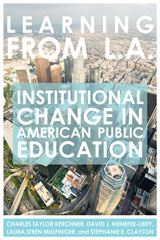
PACE (Policy Analysis for California Education) has just issued a new policy brief based on the conclusions in Learning from L.A.: Institutional Change in Public Education. It retraces a little of the historical narrative from the book and introduces the five policy levers we think are necessary to move the District past muddling through permanent crisis. Download the brief.
LLA has also been picked by Choice as one its academic books of the year. See the announcement.
Wounding Public School Choice in L.A.
Posted on | February 25, 2010 | Comments Off on Wounding Public School Choice in L.A.
The Los Angeles Unified School District board did serious damage to their Public School Choice plan on Tuesday. They amended Superintendent Ramon Cortines’ recommendations to remove the strongest of the charter school applicants, those that could have been future contenders to take over failing schools. The district has more than 100 schools that have been in federal program improvement status for more than three years. This action represents a real setback for the District as it muddles its way from a hierarchy to a network. A contest over school design is impossible unless there is a variety of applicants, and the chilled competition rather than inviting it. More about the Public School Choice process in my Huffington Post columns.
Learning About Learning Differently
Posted on | February 20, 2010 | Comments Off on Learning About Learning Differently
When we finished with Learning from L.A. and The Transformation of Great American School Districts, we came to the crashing insight that almost all the education reform we had seen was about rearranging what adults did. All the reforms had a trickle down assumption, such as, “if teaching became more interesting for teachers, students would learn more.” Across the country, but particularly in Los Angeles, we saw what Transformations co-editor dubbed “permanent crisis:” a continuing assertion that some great turning point was upon a school district, or the whole institution of public education. In the case of Los Angeles, commentators have called the school district “in crisis” for 20 years. That notion defies the conventional political wisdom, because in a crisis is supposed to draw sufficient attention from the political system to resolve the situation and move on.
I came to believe that changes in teaching and learning were the most likely social events to break the “permanent crisis” cycle. And with some assistance from the John and Dora Haynes Foundation, which has financed public policy research in Los Angeles for many decades, I have begun to study settings in which students learn differently. I’ll be reporting on those findings here and in other venues. [In this regard see my review of Disrupting Class about the capacity of new learning technologies to upend how education works. Click on the Projects link at the top of the page.]
Thus far, I have looked at the Scottish intranet system, GLOW, that has the capacity to link all 700,000 students in the country, their teachers, their families, and the national curriculum. I’m beginning to explore the question: If they can do it in Scotland, why can we? I have also been looking at the California Virtual Academy, which is growing by leaps and bounds. It combines the learn-at-home idea of home schooling with a packaged curriculum and live teacher support. Then, I traveled to St. Paul, MN, to look at the most project-based of project based learning at the Avalon school. And most recently I visited the New Tech school at Jefferson High School and The Design High School, a charter located in the Pico-Union District in L.A.
Mindworkers.com is changing
Posted on | February 11, 2010 | Comments Off on Mindworkers.com is changing
Mindworkers.com is changing. With the help of John Watson and Anja Ross, the web site will be fronted with a blog page. I will share my thoughts on education politics and policy here and invite your comments in the convenient blog fashion. I’ll also provide links to writing that appears in other places. The behind the scenes parts of Mindworkers will remain the same as before. Large projects, and papers will continue to be available by clicking on “Projects” at the top of the page. The photo gallery will continue to be viewable and updated as I get a chance. There will be some new features to the blog, too, which I will introduce as they are added.
Best,
ctk
'On California' at EdWeek.org
I have concluded my opinion blog on the Golden State's politics and education policies at EdWeek.org. An archive of the 281 posts can be reached by clicking HERE
Learning 2.0
Learning 2.0 is the next full scale version of public education, one that builds on the capacity of the Internet age.
The five elements of Learning 2.0 are explained by clicking HERE:
- Mixing acquisition of knowledge and practice, head and hands.
- An individual education plan for everyone.
- Understanding that students are the real workers in the education system.
- Unbundle teaching, testing, and mentoring.
- Add collaboration and solving tough, ambiguous problems to the list of basic skills.
Recent Posts
- Give Us 25 Minutes; You’ll Get Better 24 Hours
- New Stories on How California Flipped 7 U.S. House Seats from Red to Blue
- Old at the Beach
- A 4th of July Salute to a Courageous Judge: Remembering Paul Egly
- It’s More Than Resistance to Trump
- ‘Dreamers’ Find Allies Among Their Teachers
- How To Make the Next LAUSD Superintendent Successful
- Go, Visit the Whitney Plantation
- Nomadland: Exploring America’s Mobile Army of Older Workers
- Here’s The Peace Dividend In Los Angeles Charter School Wars
Recent Projects



About
 Charles Taylor Kerchner is an Emeritus Professor and Senior Research Fellow at Claremont Graduate University. My daily musings appear in the blog. The archives of my EdWeek blog are available via link under the 'On California' head. Some of my photography can be seen by clicking on 'Gallery.' And numerous links to academic work and other research and commentary can be found by clicking on 'Projects.'
Search
Subscribe to my Blog
Archives
- August 2020
- July 2019
- August 2018
- July 2018
- April 2018
- February 2018
- January 2018
- December 2017
- November 2017
- September 2017
- August 2017
- July 2017
- December 2015
- September 2015
- September 2014
- May 2014
- April 2014
- March 2014
- February 2014
- January 2014
- December 2013
- November 2013
- October 2013
- September 2013
- August 2013
- July 2013
- June 2013
- May 2013
- April 2013
- March 2013
- February 2013
- January 2013
- November 2012
- October 2012
- July 2012
- April 2012
- March 2012
- February 2012
- January 2012
- December 2011
- November 2011
- October 2011
- September 2011
- August 2011
- July 2011
- June 2011
- May 2011
- April 2011
- March 2011
- February 2011
- January 2011
- December 2010
- November 2010
- September 2010
- August 2010
- July 2010
- June 2010
- May 2010
- April 2010
- March 2010
- February 2010
- May 2009
- August 2008
- June 2008
- September 2007
- August 2007
- December 2005
- June 2005
- January 1999
Blogs I Read
- Arts & Letters Daily
- California Watch, reporting from the Center for Investigative Journalism
- Conditions of Education from PACE
- District Dossier
- Ed Source Today
- Joanne Jacobs–Linking and Thinking
- L.A. School Report
- Politics K-12: Michele McNeil and Alyson Klein
- Rough & Tumble: Today's California Politics News
- Teacher Beat: Stephen Sawchuk
- The Hechinger Report
- The Quick and the Ed–Education Sector
- This Week in Education: Alexandar Russo